Managing Multiple Jewelry SKUs With One Manufacturer
Managing Multiple Jewelry SKUs With One Manufacturer
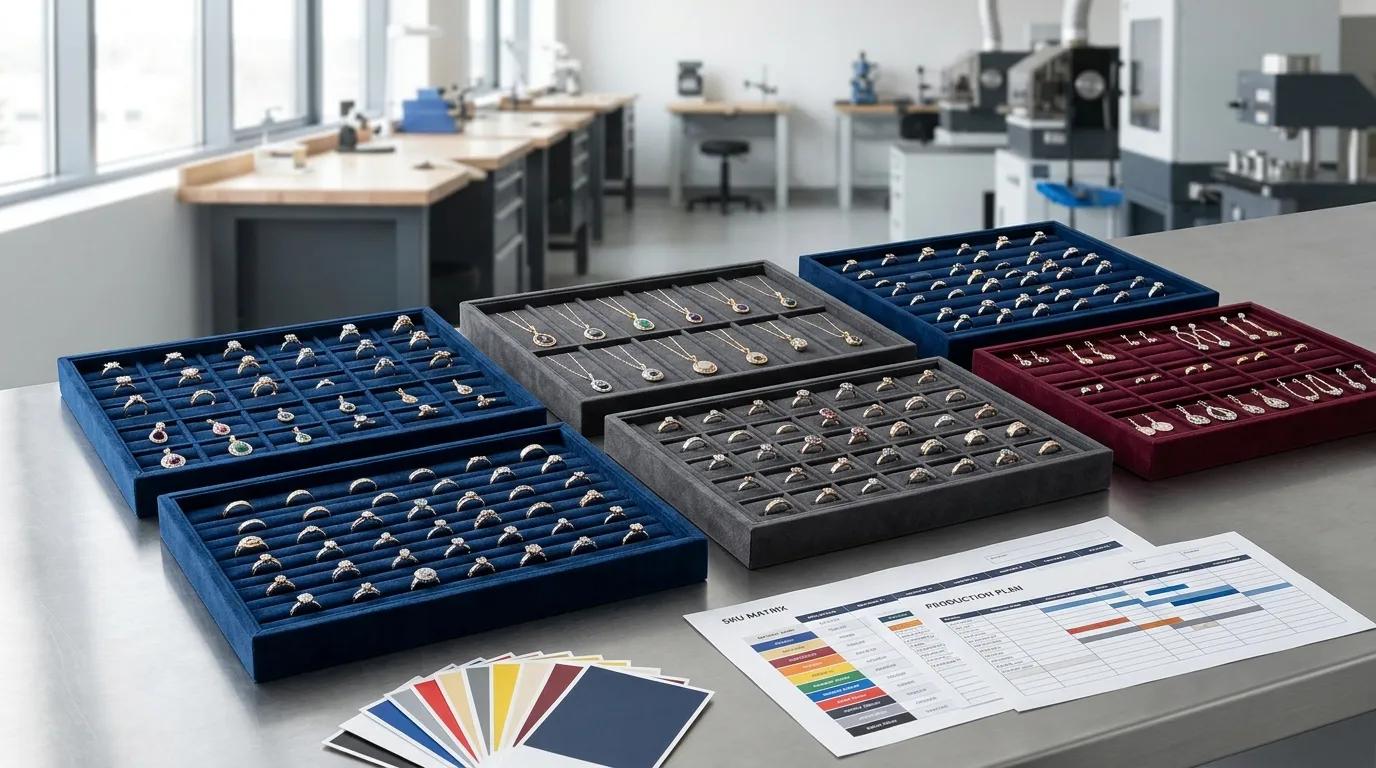
Managing multiple jewelry SKUs with one manufacturer can simplify supplier coordination, but it also creates challenges in product specifications, sampling, production scheduling, and quality control. The key is to manage each SKU as a clearly defined production requirement while coordinating the shared materials, components, and processes across your collection.
At SSJew, our custom jewelry manufacturing capabilities cover areas such as CAD, prototyping, sampling, materials, surface finishing, and quality inspection. For a multi-SKU project, the first step is to establish what makes each product different, which requirements can be shared, and which details must remain specific to an individual SKU.
Whether you are developing a new collection or consolidating production with one supplier, the following practices can help you organize your product range and make better sourcing decisions.
1. Why Multi-SKU Jewelry Production Becomes Difficult
A jewelry collection may contain several designs, with each design available in multiple sizes, finishes, stone options, or packaging configurations. What appears to be a small collection can therefore involve many distinct production combinations.
For example, one bracelet design may have two lengths and three plating colors. If every combination is sold and managed separately, the design represents six potential SKUs. Each combination may require its own product identification and clear instructions for production and inspection.
Common challenges include:
-
Specification confusion: Similar designs are produced with the wrong dimensions, stones, or finishes.
-
Material coordination: Several SKUs depend on shared components or materials with different requirements.
-
Sampling complexity: Approval for one variant is incorrectly treated as approval for every variant.
-
Scheduling conflicts: Products requiring different processes or approvals are assumed to be ready at the same time.
-
Reorder inconsistency: Previous specifications or approved references are difficult to identify when replenishing stock.
Working with one manufacturer can reduce the number of supplier relationships you manage. However, it does not automatically eliminate these risks. You still need a structured way to organize product information and communicate changes.
2. Build a Clear SKU and Specification Matrix
A SKU matrix is one of the most useful tools for managing a multi-product jewelry order. It connects each product identifier to the specifications required to manufacture and inspect that product.
Your matrix should include the following fields where applicable:
Field
Information to Record
SKU and product name
A unique identifier for each sellable variant
Design reference
CAD file, drawing, or approved design version
Base material
Sterling silver, brass, gold, or another specified material
Dimensions
Length, width, thickness, ring size, or other critical measurements
Finish and color
Agreed polishing, plating, PVD, or surface-finishing requirements
Stones and components
Stone type, size, setting, findings, and relevant component references
Packaging
Required packaging type and any SKU-specific instructions
Order quantity
Quantity for each SKU, not just the collection total
Approval status
Pending, under review, approved, or revised
Inspection criteria
Critical dimensions, appearance requirements, and other acceptance checks
The matrix should function as an index to the approved production information, not as a replacement for detailed drawings or specifications.
Separate product families from individual SKUs
Organize your collection into product families first, then identify the individual SKUs within each family. This makes it easier to see which products share a design and which require different manufacturing instructions.
For example, two necklace SKUs may share the same pendant design but use different chain lengths. The pendant specification may be shared, while the chain length, assembly requirements, and final product dimensions need separate confirmation.
This distinction helps you avoid duplicating every document unnecessarily while ensuring that important differences are not overlooked.
Record materials, finishes, and components
Do not assume that similar-looking products can use identical production instructions. A sterling silver design and a brass version may share a visual concept but require different material specifications and processing considerations.
Likewise, two gold-colored products may have different base materials or finishing requirements. Record these differences explicitly rather than relying on product names or color descriptions.
If multiple SKUs share a component, identify the common component reference and document any exceptions. This can help you coordinate purchasing and production without confusing shared parts with finished-product requirements.
3. Coordinate Sampling and Sample Approval
Sampling becomes more complicated as the number of SKUs increases. You need to know which variants have been sampled, which are approved, and whether an approval applies to the entire product family or only to one specific version.
Before sampling begins, group products according to their actual manufacturing similarities. A shared design may allow some specifications to be reused, but changes in dimensions, materials, stone settings, or finishes may require additional review or separate samples.
For every sample, record:
-
The SKU or product family it represents.
-
The design and specification version.
-
The material and finish being evaluated.
-
Any outstanding changes or conditions.
-
The person authorized to approve it and the approval date.
When reviewing samples, check the characteristics that matter to each variant. For example, a different chain length may require a dimensional check, while a different plating color requires a review of the agreed appearance reference.
Do not assume that approval of a polished silver sample automatically approves a gold-colored version of the same design. The underlying design may be shared, but the finish and its acceptance requirements are different.
At SSJew, sampling and prototyping can form part of the development process where applicable to the project. Before proceeding, confirm which samples are required, what each sample is intended to verify, and which approvals are needed before bulk production.
4. Plan Production Across Multiple SKUs
A multi-SKU order should be planned around both the individual products and the manufacturing processes they share.
Some SKUs may use common components, similar construction methods, or the same finishing category. Others may require different tooling, stone-setting work, or surface treatments. These differences can affect the order in which work is performed and the dependencies between production stages.
Ask your manufacturer to clarify:
-
Which SKUs can share materials, components, or production steps.
-
Which products require separate tooling, sampling, or finishing arrangements.
-
Which approvals must be completed before production can proceed.
-
Whether one SKU depends on components being ready for another process.
-
How partial delays will affect the overall order.
Combining compatible work may improve coordination, but grouping everything into one production batch is not always the most efficient choice. A different finish, material, or construction method may justify a separate production sequence.
You should also distinguish the total order quantity from the quantity of each SKU. A collection containing 1,000 pieces across ten variants does not mean every variant has an order quantity of 1,000. Confirm how quantities affect quotation, minimum order requirements, and scheduling for each product or production group.
5. Maintain Quality and Sample-to-Bulk Consistency
A single collection-wide quality statement is not enough when different SKUs have different critical requirements.
Your inspection plan should identify the characteristics that matter for each product. For a ring, these may include size, band dimensions, stone setting, and surface finish. For a chain, length, clasp function, component integrity, and appearance may be more relevant.
Establish two levels of control:
Shared quality requirements: Common expectations for documentation, workmanship, appearance, packaging, and agreed inspection procedures.
SKU-specific requirements: Product dimensions, stone placement, finish, component configuration, and any other characteristics that differ between variants.
This approach prevents an inspection checklist designed for one product from being applied incorrectly to another.
You should also clarify how approved samples will be used as references during production and inspection. A sample helps communicate the intended result, but measurable requirements should remain documented separately where necessary.
At SSJew, quality inspection can be aligned with the requirements agreed for the project. Confirm which checks apply to each SKU, when inspections take place, and how nonconforming products will be identified and handled. Do not assume that every SKU receives identical checks if its design and risk profile require different controls.
For repeat orders, retain the relevant specification versions, approved references, material requirements, and inspection criteria. This provides a clearer basis for evaluating differences between production batches.
6. Control Costs, MOQ, and Reorders
Using one manufacturer may simplify communication and create opportunities to coordinate shared materials or processes. However, it does not guarantee a lower unit cost, a lower MOQ, or a shorter lead time.
Costs may vary by SKU because of differences in material consumption, design complexity, tooling, stone setting, finishing, assembly, and packaging. Small quantities across many variants may also create different production requirements from a large quantity of one design.
When requesting a quotation, provide the quantity for each SKU and identify any shared components or processes. Ask which costs are common to the collection and which apply to individual products.
For replenishment orders, use the original SKU identifiers and approved specifications rather than relying on product names alone. If you change a finish, stone, dimension, or component, record the revision and ask for confirmation of its impact on cost and production timing.
This is especially important when your collection contains similar products that differ in only one detail. A clear revision history helps you avoid ordering an outdated version or comparing quotations based on different specifications.
7. How to Evaluate a Manufacturer for Multi-SKU Production
Before consolidating your collection with one supplier, ask how the manufacturer handles product information and production changes.
Useful questions include:
-
Can you maintain separate specifications for each SKU and its variants?
-
How do you identify shared components and product-specific requirements?
-
How are sample approvals and design revisions recorded?
-
How do you coordinate production when different SKUs require different processes?
-
What inspection criteria apply to each product?
-
How are specifications retained for repeat orders?
Look for clear, verifiable answers rather than general assurances. A supplier should be able to explain how your requirements will be communicated and how changes will be reflected in the relevant production information.
You should also assess whether the manufacturer understands the commercial implications of your collection structure. If a design change affects several related SKUs, you need to understand the potential impact before approving it.
FAQ
Can one jewelry manufacturer handle multiple SKUs?
Potentially, yes. Suitability depends on the manufacturer's capabilities, the materials and processes required, order quantities, and production capacity. Confirm these factors against your actual product range.
Should every jewelry SKU have its own sample?
Not necessarily. Shared designs may allow some specifications to be reused, but variants with meaningful differences in material, finish, dimensions, or construction may need separate samples or additional validation.
Does combining multiple SKUs reduce production costs?
Not automatically. Shared components and compatible processes may create efficiencies, while small quantities, complex finishes, separate tooling, or additional approvals may add costs. Request a quotation based on your SKU-level quantities and specifications.
How can I keep quality consistent across multiple jewelry SKUs?
Use a shared quality framework alongside SKU-specific specifications, approved references, and inspection criteria. Record changes and retain production information for future reorders.
Conclusion: Manage the Collection, Not Just the Order
Managing multiple jewelry SKUs with one manufacturer requires more than submitting a combined purchase order. You need clear product identifiers, controlled specifications, organized sample approvals, coordinated production planning, and quality requirements tailored to each variant.
At SSJew, our custom jewelry manufacturing services can support projects involving design development, sampling, materials, surface finishing, and quality inspection as applicable to the agreed requirements.
If you are planning a new collection or consolidating several jewelry designs with one manufacturing partner, share your SKU list, design files, material preferences, finish requirements, and estimated quantities with us. We can review the project requirements with you and discuss the manufacturing considerations that need to be clarified before production begins.