Jewelry Finish Options: Polished, Brushed, Matte and Textured
Jewelry Finish Options: Polished, Brushed, Matte and Textured
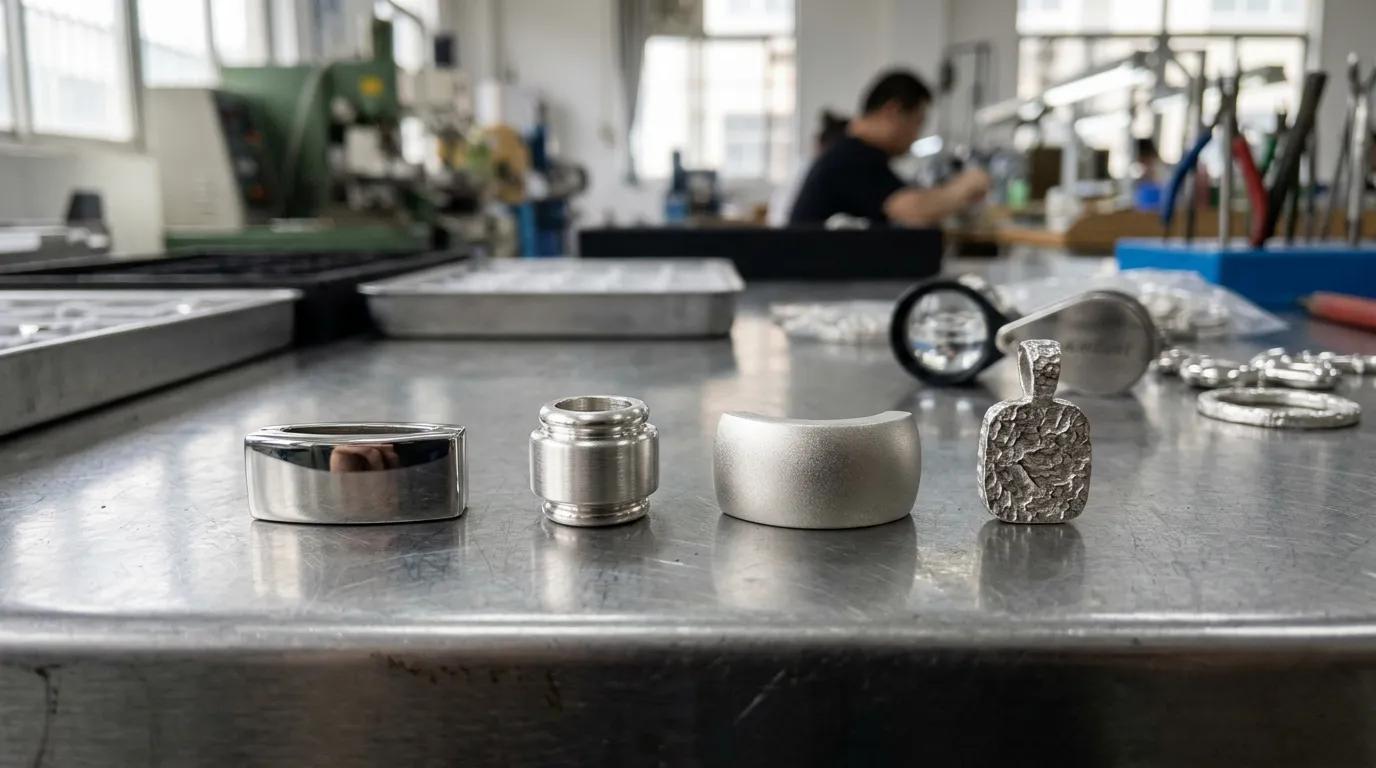
Choosing the right jewelry finish affects more than how a product looks. It influences how light reflects from the surface, how visible fingerprints and scratches may be, how small design details appear, and how consistently your jewelry can be reproduced in production.
For jewelry brands, retailers, and product developers, polished, brushed, matte, and textured finishes offer different ways to define a product's appearance. However, the finish that works well on a design sketch may require adjustments when applied to a real metal component, especially when the piece includes curved surfaces, narrow edges, recessed details, stones, or decorative patterns.
At SSJew, we approach finish selection as part of the manufacturing process, not simply as a final aesthetic choice. Understanding how each finish is produced helps you choose a suitable option, communicate your requirements clearly, and reduce the risk of differences between your approved sample and bulk production.
What Is a Jewelry Finish?
A jewelry finish describes the surface appearance and texture of a metal component. It determines whether the surface looks highly reflective, softly directional, low in reflectivity, or visibly patterned.
A finish is different from a metal's color. For example, sterling silver can have a polished, brushed, or matte surface. Brass can also be finished in different ways, while additional plating or coating may change the final color and surface characteristics.
When developing custom jewelry, you should consider three separate elements:
-
Base material: The underlying metal, such as 925 sterling silver or brass.
-
Surface finish: The texture and reflectivity created through polishing, abrasion, or other finishing processes.
-
Color treatment: The appearance created by the metal itself or by an applied finish, such as gold-colored electroplating or PVD coating.
These elements interact, but they are not interchangeable. A gold-colored finish does not automatically mean a mirror-polished surface, and a matte appearance does not necessarily indicate a particular coating.
Four Main Jewelry Finish Options
1. Polished Finish: Bright and Reflective
A polished finish creates a smooth-looking surface with strong light reflection. Depending on the level of polishing, it can range from a bright gloss to a mirror-like appearance.
Polished surfaces are commonly used for rings, pendants, earrings, bracelets, and decorative metal components where brightness and clean reflections are important.
Manufacturing considerations
Achieving a consistent polished finish requires suitable surface preparation and controlled polishing. The process must remove or reduce surface irregularities without unnecessarily changing the intended geometry.
This matters when your design includes sharp edges, engraved details, narrow grooves, or raised patterns. Excessive polishing can soften edges and reduce the definition of small features. Deep scratches may also require additional work before a satisfactory surface can be achieved.
Before approving a sample, inspect the surface under consistent lighting. Look for visible scratches, pits, uneven reflections, and areas that appear duller than the surrounding metal.
When should you choose it?
Choose polished finishes when your product concept depends on brightness, clean reflections, or a smooth metallic appearance. If your design has many fine details, confirm that the required polish can be achieved without compromising those features.
2. Brushed Finish: Directional and Refined
A brushed finish creates fine, directional lines across a metal surface. These lines produce a controlled, linear appearance with less mirror-like reflection than a highly polished surface.
Brushed finishes can suit minimalist rings, bracelets, pendants, geometric earrings, and designs that use clean lines or understated metallic surfaces.
Manufacturing considerations
The direction, fineness, and consistency of the brushing pattern all affect the final result. A linear pattern may look uniform on a flat component but become more difficult to control around curved surfaces or changing angles.
If different components of one product require the same visual direction, communicate that requirement before production. Otherwise, the brushing pattern may appear inconsistent when the pieces are assembled.
You should also consider how the finish interacts with engraved lines, stone settings, and polished borders. Combining brushed and polished surfaces can create contrast, but it requires clear boundaries between the two treatments.
When should you choose it?
Choose brushed finishes when you want visible surface direction and a restrained metallic appearance. For repeat production, specify the brushing direction and provide an approved reference sample rather than relying on the word "brushed" alone.
3. Matte Finish: Soft and Low-Reflective
A matte finish reduces strong surface reflections, creating a softer appearance than a highly polished finish. Depending on the process, the result may look finely satin-like or more visibly granular.
Matte finishes work well for understated jewelry designs, contemporary collections, and products where you want the shape and overall silhouette to stand out without strong reflections.
Manufacturing considerations
"Matte" describes a broad visual category rather than one precise production method. Different surface preparation techniques can produce different levels of reflectivity and texture.
The underlying material and any subsequent plating or coating can also influence the final appearance. A matte surface on one metal should not automatically be treated as identical to a matte surface on another.
You should assess the approved sample after all intended surface treatments have been completed. Inspecting the base metal alone may not accurately represent the final product.
Matte surfaces can also show wear, polished contact points, or uneven handling marks differently from highly reflective surfaces. The result depends on the surface structure, material, coating, and conditions of use. A matte finish should therefore not be assumed to be more scratch-resistant simply because it hides reflections.
When should you choose it?
Choose matte finishes when you want low reflectivity and a softer visual effect. Confirm the required appearance with a physical sample, particularly if your collection combines matte areas with polished details.
4. Textured Finish: Visible Pattern and Surface Character
A textured finish introduces a deliberate pattern or surface variation. Examples include hammered, hammered-look, stippled, and other patterned metal surfaces.
Textured finishes can give a product a distinctive visual identity. They are useful for statement jewelry, organic designs, decorative pendants, and collections built around repeated surface patterns.
Manufacturing considerations
The production method depends on the desired pattern and component geometry. Texture may be created through forming, stamping, machining, or other suitable processes. The best approach depends on the design rather than on one universal technique.
Texture depth, spacing, and consistency matter. A pattern that looks attractive on a large pendant may become crowded or lose definition on a small earring. Deep recesses may also be more difficult to finish uniformly than accessible raised areas.
If the design includes plating, you should confirm how the surface pattern will appear after the complete finishing process. Coatings can affect the visual definition of fine details, and recessed areas may behave differently from exposed surfaces during finishing.
When should you choose it?
Choose textured finishes when the surface pattern is an important part of your product's identity. Provide close-up reference images or an approved physical sample, and confirm the acceptable variation before authorizing bulk production.
How Do the Four Finishes Compare?
Finish
Visual effect
Main production consideration
Best suited to
Polished
Bright, reflective
Surface defects and detail preservation
Clean, glossy designs
Brushed
Directional lines
Pattern direction and uniformity
Linear, minimalist designs
Matte
Soft, low-reflective
Consistent texture and reflectivity
Understated designs
Textured
Visible surface pattern
Pattern definition and repeatability
Decorative, distinctive designs
No finish is universally better than the others. Your decision should reflect the product's design, intended price positioning, material, and production requirements.
Manufacturing Factors That Affect Finish Quality
Selecting a finish is only the first step. Several manufacturing factors determine whether the intended appearance can be achieved consistently.
Base Material and Component Geometry
The same finish specification may produce different visual results on different materials or component shapes. Flat surfaces, curved edges, recessed areas, and narrow sections present different finishing challenges.
During custom jewelry development, we consider the intended design and manufacturing route when assessing how a surface finish can be applied. CAD and prototyping can help identify areas where fine details, geometry, or component transitions may require additional attention.
Surface Preparation and Plating
Polishing, brushing, and other surface treatments establish the underlying surface condition. If defects remain before plating, the final finish may not conceal them.
Electroplating and PVD are color or surface-treatment processes, not synonyms for polished, brushed, or matte finishes. Their suitability depends on the material, required appearance, component design, and production specification.
For custom gold-colored jewelry, for example, you should specify both the desired color and the surface appearance. Confirm the complete finishing sequence with your manufacturing partner rather than treating color and texture as one requirement.
Sample-to-Bulk Consistency
An approved sample establishes the visual reference for production, but it does not automatically guarantee identical results across every component or batch.
At SSJew, our manufacturing and quality discussions can be aligned around the agreed design, material, surface treatment, and inspection requirements. For your project, the acceptance criteria should identify the expected finish, relevant visual details, and any permitted variation.
If a collection combines polished borders with brushed centers or textured recesses, these details should be confirmed before bulk production begins.
How to Specify and Inspect Your Jewelry Finish
A clear finish specification reduces ambiguity between your design team and manufacturing partner.
Before confirming an order, provide:
-
Finish type: Identify whether each surface should be polished, brushed, matte, or textured.
-
Reference images or samples: Include close-up images and, where possible, a physical sample showing the intended result.
-
Direction and pattern: Specify brushing direction or the intended texture pattern where relevant.
-
Color and material: State the base metal and required final color or plating.
-
Critical details: Identify areas where edges, engravings, stone settings, or transitions between finishes must remain clearly defined.
-
Inspection requirements: Agree on lighting conditions, viewing distance, inspection areas, and acceptable visual variation.
For quality inspection, assess the product under consistent conditions and compare it with the approved reference. Polished surfaces require attention to scratches and uneven reflections; brushed surfaces require attention to direction and pattern consistency; matte surfaces require attention to reflectivity and surface uniformity; textured surfaces require attention to pattern definition and coverage.
You should also confirm whether the inspection requirements apply to every piece, a defined sample of the batch, or specific critical features. The appropriate inspection plan depends on the product and the quality agreement.
Common Mistakes When Choosing a Jewelry Finish
Choosing by appearance alone. A finish that looks suitable in a rendering may be difficult to reproduce on a small or complex component. Review a physical sample before final approval.
Treating finish and color as the same specification. Specify the surface texture and final color separately to avoid misunderstandings.
Ignoring fine details. Polishing can soften edges, while texture or surface treatments can change how small features appear. Review critical areas during development.
Assuming matte means scratch-resistant. Lower reflectivity does not automatically indicate greater durability. Discuss the actual material and coating requirements for your intended use.
Approving a sample without defining acceptance criteria. Use the approved sample as a reference and document the details that matter for repeat orders.
Frequently Asked Questions
Which jewelry finish is the most durable?
Durability depends on the base material, surface treatment, coating, design, and use conditions. Polished, brushed, matte, and textured finishes describe appearance rather than a universal durability ranking. Confirm the relevant wear and coating requirements for your product.
Is a matte finish better than a polished finish?
Neither is inherently better. Matte finishes provide softer reflections, while polished finishes create brighter surfaces. Your choice should reflect the design, intended appearance, and maintenance expectations.
Can one piece of jewelry combine different finishes?
Yes. A design can combine polished, brushed, matte, or textured areas. You should identify each finish separately and confirm the transitions on a sample before bulk production.
Do different finishes affect custom jewelry manufacturing costs?
They can. Costs depend on the finishing method, component geometry, detail requirements, surface preparation, production volume, and potential rework. A design with multiple finishes may require additional processing and inspection compared with a simpler surface treatment.
How can I ensure consistent finishes in bulk production?
Provide a clear specification, approve a representative sample, document critical visual requirements, and agree on an inspection method. For repeat orders, retain the relevant reference information and confirm any material or process changes before production.
Conclusion: Choose a Finish That Can Be Reproduced
Polished, brushed, matte, and textured finishes each offer different design possibilities. The right option is the one that achieves your intended appearance while remaining practical for the material, component geometry, manufacturing process, and quality requirements.
At SSJew, we support custom jewelry development by considering surface finishing alongside material selection, design details, sampling, and quality inspection. If you are developing a new collection or adapting an existing design, share your drawings, reference images, preferred materials, and finish requirements with our team.
We can discuss the manufacturing considerations for your project and help you define the information needed to evaluate a suitable production approach.
Planning a custom jewelry project? Contact SSJew to discuss your design, material, surface finish, and sampling requirements.