Common Jewelry Casting Defects and How to Prevent Them
Common Jewelry Casting Defects and How to Prevent Them
Common Jewelry Casting Defects and How Manufacturers Prevent Them
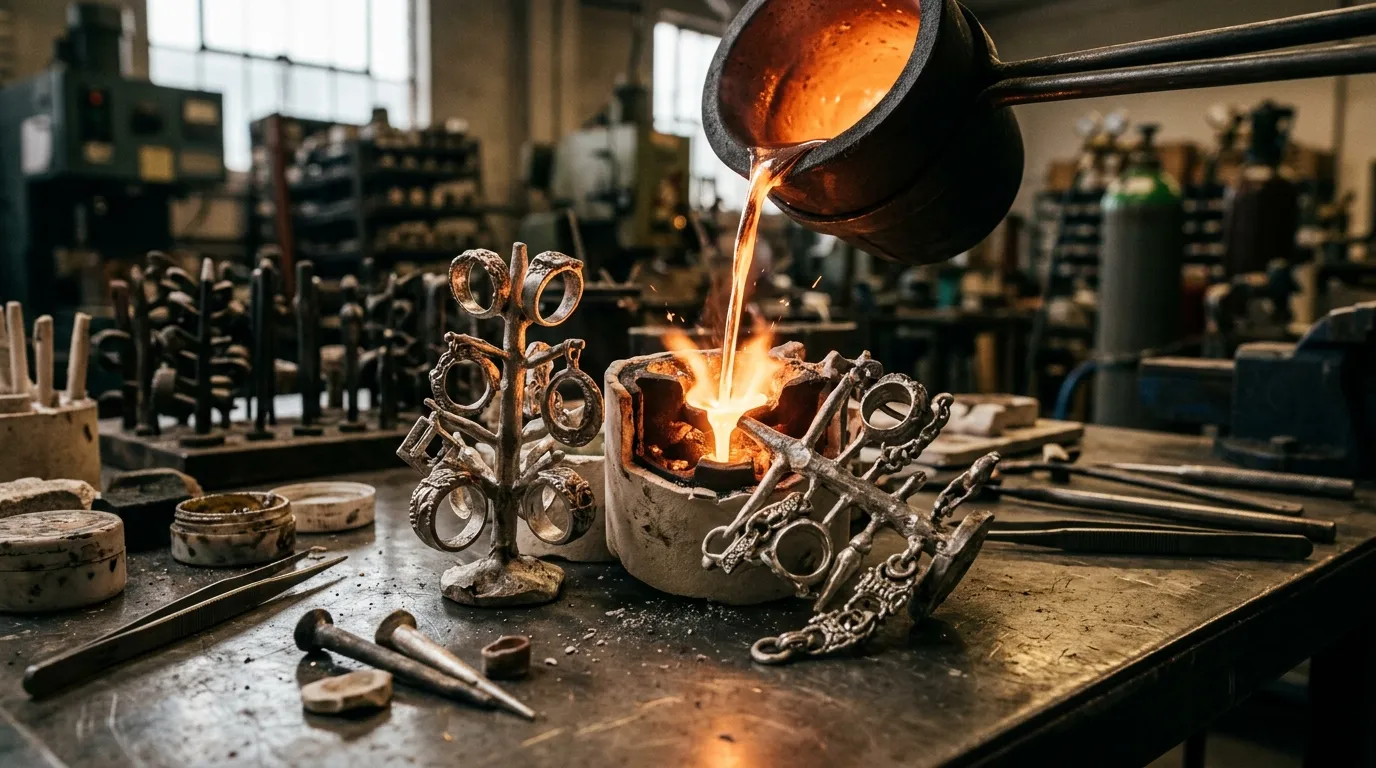
Jewelry casting defects can affect a product's appearance, dimensions, structural integrity, and final production cost. Small surface pits may become more visible after polishing or plating, while internal porosity or cracks can create problems that are not easily identified through a basic visual inspection.
If you are developing custom rings, pendants, earrings, or other cast metal components, understanding these defects helps you evaluate samples and discuss production risks before approving a bulk order.
At SSJew, we approach custom jewelry development by considering design requirements, materials, finishing, and quality expectations together. The following guide explains eight common jewelry casting defects, why they occur, and what you should discuss with your manufacturing partner to reduce the risk of defects reaching finished products.
Why Casting Quality Matters in Jewelry Manufacturing
Casting creates a metal component from a prepared mold or cavity. In jewelry production, the result must often undergo additional operations, such as trimming, polishing, stone setting, electroplating, and assembly.
A defect discovered early may be easier to assess before additional processing increases the cost of the affected piece. By contrast, a casting problem identified after polishing or plating may require more rework, and some defects cannot be corrected without compromising the design or component strength.
Your inspection plan should therefore distinguish between cosmetic imperfections, dimensional problems, and defects that may affect structural integrity.
8 Common Jewelry Casting Defects
1. Gas Porosity
What it looks like: Small, rounded holes or cavities within or on the surface of a cast metal component.
Gas porosity occurs when gas becomes trapped in the metal during casting and remains as the metal solidifies. The location and visibility of the resulting pores depend on the process conditions and component geometry.
Why it matters: Surface pores may become visible after polishing or plating. Internal pores may be harder to detect but can be important when they affect a thin section or a load-bearing feature.
How to prevent it: Gas-related porosity requires investigation of the casting process rather than simply removing visible imperfections. Depending on the process, relevant factors may include mold conditions, gas evacuation, metal handling, and casting parameters.
What you should check: Inspect visible surfaces and critical structural areas. If porosity is suspected in a feature that must withstand stress, visual inspection alone may not establish whether the component is acceptable.
2. Shrinkage Porosity and Cavities
What it looks like: Irregular cavities or voids associated with metal solidification, sometimes concentrated in thicker sections or junctions.
As molten metal cools and solidifies, it contracts. If the casting design and feeding conditions do not adequately accommodate this shrinkage, voids may form.
Why it matters: Shrinkage-related defects can affect both appearance and structural integrity. Their significance depends on the size, location, and function of the affected component.
How to prevent it: Prevention may involve reviewing section thickness, transitions between thick and thin areas, feeding paths, and the overall casting design. The appropriate correction depends on the defect's location and confirmed cause.
What you should check: Pay particular attention to thick junctions, changes in cross-section, and areas that perform a structural function. Do not assume that a surface cavity is merely cosmetic without assessing its depth and significance.
3. Surface Pits and Roughness
What it looks like: Uneven surfaces, small depressions, rough patches, or areas that remain visibly irregular after initial finishing.
Surface roughness can have several causes, including mold or investment surface conditions, contamination, metal-related issues, or the way the casting process reproduces fine details.
Why it matters: Polishing may improve some surface irregularities, but it can also remove material and soften design details. Plating can reveal imperfections that were not obvious on the unfinished component.
How to prevent it: Review the required surface quality during sampling. Consider whether the design includes fine grooves, narrow edges, recessed details, or broad surfaces where imperfections will be particularly visible.
What you should check: Examine the casting before extensive polishing. Distinguish between removable surface irregularities and deeper cavities that may require a process correction or rejection.
4. Misruns and Incomplete Filling
What it looks like: Missing sections, incomplete edges, rounded-off details, or features that have not been fully reproduced.
A misrun occurs when molten metal fails to fill the intended mold cavity completely. Contributing factors may include insufficient metal fluidity, heat loss, restricted flow, or unsuitable casting conditions.
Why it matters: Missing material can change the product's appearance, dimensions, fit, and functionality. Fine decorative details may be particularly sensitive to incomplete filling.
How to prevent it: Review the component geometry and casting feasibility before production. CAD review and prototyping can help identify delicate features, narrow sections, or design transitions that may require adjustment.
What you should check: Compare the cast component with the approved design. Inspect small openings, thin projections, decorative patterns, and attachment points. A component that looks generally correct may still have an incomplete critical feature.
5. Cracks and Hot Tearing
What it looks like: Visible cracks, splits, or separations in the cast metal.
Cracks can arise at different stages of production. Hot tearing is associated with stresses that develop while the metal is solidifying and its contraction is restricted. Other cracks may have different causes and require separate investigation.
Why it matters: Cracks can compromise component strength and may worsen during subsequent finishing, assembly, or use. Their importance depends on their location and the role of the affected section.
How to prevent it: Prevention may require reviewing component geometry, solidification behavior, material characteristics, and relevant casting conditions. The correct response depends on identifying the actual cause rather than treating every crack in the same way.
What you should check: Inspect thin sections, junctions, and connection points carefully. A suspected structural crack should be assessed before the component proceeds to polishing, stone setting, or assembly.
6. Investment Inclusions and Residue
What it looks like: Embedded particles, rough localized areas, or residues associated with the mold or investment material.
In investment casting, the mold must reproduce the intended design while remaining suitable for the casting process. Problems involving investment preparation, mold integrity, or removal may contribute to surface contamination or inclusions.
Why it matters: Inclusions and residue can affect surface appearance and may complicate polishing or subsequent finishing. If an inclusion is embedded in the metal, simply cleaning the surface may not resolve the problem.
How to prevent it: Relevant controls may include investment preparation, mold handling, burnout conditions, and appropriate cleaning procedures. The exact corrective action depends on whether the issue originates in the mold, the casting, or post-casting treatment.
What you should check: Examine irregular areas before polishing. If contamination or inclusions are suspected, ask for the cause to be assessed before deciding whether the component can be reworked.
7. Flash and Excess Metal
What it looks like: Thin metal projections, unwanted ridges, or excess material along parting lines or around features.
Flash can develop when metal enters a gap between mold sections or when the mold does not close or fit as intended. Other excess material may arise from the casting setup and require removal during finishing.
Why it matters: Excess metal can affect appearance, component fit, and finishing time. Removing it may also alter an edge or decorative feature if the work is not controlled carefully.
How to prevent it: Review mold condition, alignment, and the intended parting arrangement as appropriate to the casting method. Define which edges and details must be preserved during trimming and finishing.
What you should check: Inspect parting lines, openings, attachment points, and areas that must fit against another component. Confirm that excess material has been removed without damaging the intended geometry.
8. Dimensional Distortion
What it looks like: Warped components, uneven profiles, incorrect dimensions, or parts that do not align with mating components.
Distortion may result from uneven cooling, residual stress, handling, or other process-related factors. Thin or asymmetrical designs can present different challenges from thicker, more uniform components.
Why it matters: A component may appear acceptable at first glance but fail to fit a clasp, chain, setting, or adjoining part. Correcting distortion after subsequent finishing can be difficult or may affect the final appearance.
How to prevent it: Review the design geometry and critical dimensions during development. Define tolerances for features that affect fit, function, and assembly, and confirm those requirements before production.
What you should check: Compare critical measurements with the approved drawing or specification. Assess flatness, alignment, symmetry, and component fit where relevant rather than relying only on visual appearance.
How Manufacturers Prevent Jewelry Casting Defects
Effective prevention starts before casting and continues through inspection and finishing.
Design review: CAD review can help identify thin sections, abrupt thickness changes, difficult-to-fill details, and geometry that may be challenging to reproduce consistently.
Process control: Casting variables must be appropriate for the selected material, equipment, mold system, and component design. The relevant controls depend on the actual casting process; a single universal set of parameters is not suitable for every jewelry component.
Early inspection: Examine cast components before extensive polishing, plating, or assembly. This helps distinguish casting defects from problems introduced during later processing.
Corrective action: When a defect is identified, investigate its likely cause and determine whether the appropriate response is rework, recasting, process adjustment, or rejection. Cosmetic repair is not an appropriate substitute for assessing a potentially structural defect.
At SSJew, we can discuss your design, material, finishing, and inspection requirements during custom jewelry development. The specific casting controls and inspection methods for your project should be confirmed against the actual production process.
How to Inspect Cast Jewelry Before Finishing
Before approving a sample or bulk production, establish an inspection plan that addresses the product's critical requirements.
Inspection area
What you should verify
Surface condition
Pits, rough patches, inclusions, and visible imperfections
Completeness
Fully formed edges, openings, and decorative details
Structural integrity
Suspected cracks, significant voids, or other critical defects
Dimensions
Critical measurements and specified tolerances
Component fit
Alignment and compatibility with adjoining parts
Finishing readiness
Whether the casting can proceed without unacceptable rework
Not every defect can be confirmed through visual inspection. If a critical component may contain internal porosity or another subsurface defect, an appropriate additional assessment may be necessary.
For repeat orders, retain the approved sample and technical specifications. Agree on defect classifications, inspection methods, and acceptance criteria before production. AQL-based sampling may support a defined quality plan, but critical structural requirements should be addressed explicitly rather than left to a general sampling threshold.
Cost and Procurement Considerations
Casting defects can create costs beyond the affected component. Rework may consume additional labor and finishing resources, while rejected components may require recasting and disrupt downstream production.
The financial impact depends on the defect, material value, component complexity, production stage, and whether the problem can be corrected without compromising quality. A minor surface issue identified early is not equivalent to a structural defect discovered after plating or stone setting.
When evaluating a manufacturing partner, ask how casting quality is assessed, when defects are inspected, and how nonconforming components are handled. Also confirm which design requirements may affect manufacturability, sampling, or production planning.
The goal is not simply to eliminate visible defects at the final stage. It is to identify foreseeable problems early enough to make an informed production decision.
Frequently Asked Questions
What is the most common jewelry casting defect?
There is no universal ranking that applies to every metal, casting method, and design. Porosity, surface imperfections, incomplete filling, and dimensional problems are useful categories to discuss during development and inspection.
Can jewelry casting porosity be repaired?
Some localized surface imperfections may be suitable for controlled rework, depending on the material and design. Internal or extensive porosity may require rejection or recasting. The appropriate decision depends on the defect's depth, location, and effect on structural integrity.
Can polishing remove casting defects?
Polishing can improve some surface irregularities, but it cannot reliably correct every casting defect. Deep cavities, internal porosity, cracks, and incomplete features require proper assessment rather than simply removing more metal.
How can I reduce casting defects in bulk jewelry production?
Confirm design feasibility, approve a representative sample, define critical dimensions and acceptable surface conditions, and agree on inspection and corrective-action requirements before bulk production.
Conclusion
Jewelry casting defects can affect appearance, dimensional accuracy, structural integrity, and production cost. Understanding the likely causes helps you distinguish between problems that may be corrected through finishing and those that require changes to the casting process or rejection of the component.
At SSJew, we can discuss your custom jewelry design, material selection, finishing requirements, and quality expectations to help define the information needed for production planning.
Developing a custom jewelry collection? Contact SSJew to discuss your design specifications, sampling requirements, and casting-related quality considerations before bulk production.